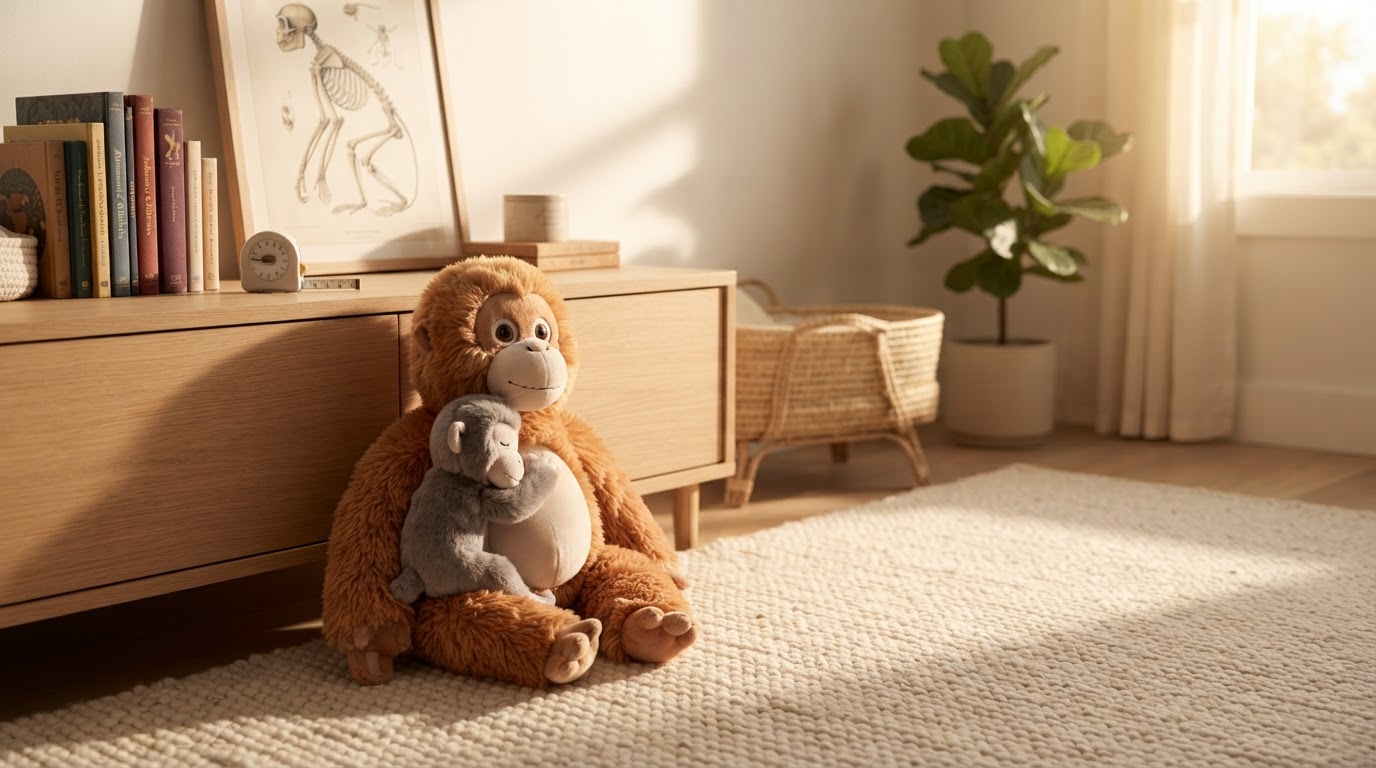
The Safer Plush Isn’t Always the Softest Monkey in the Room
Softness is the first thing most adults test on a plush toy; in my experience, it is also the least useful signal. A 20-second seam check tells you more than a cheek rub, and the number I keep coming back to is 1.25 inches: if a detached piece can fit inside the U.S. Consumer Product Safety Commission’s small-parts cylinder, it does not belong near children under 3.
That is the lens I use for the Mama Punch Monkey Plush Toy. Yes, it needs to feel huggable. But the better question is whether it can survive the real abuse plush toys get: yanked by one arm, dragged through a car footwell, slept on during a cold, and washed after an applesauce incident nobody admits to causing.
Most plush buying advice treats stuffed animals like decor. I think that is backwards. A child does not “display” a plush. A child stress-tests it.
The plush-toy category hides the part parents actually need to judge
The public conversation around plush toys is dominated by cute: bigger eyes, softer fur, viral characters, squishy stuffing. That is understandable. Plush is emotional merchandise. A monkey with a mischievous face does a job a hard plastic toy cannot: it becomes a character before the child invents the story.
But from a safety and durability standpoint, plush toys are not one category. They are a bundle of small engineering decisions:
- embroidered eyes versus plastic safety eyes
- short pile fabric versus long faux fur
- internal squeakers, beans, pellets, batteries, or none
- stitched-on accessories versus loose add-ons
- machine-washable construction versus spot-clean-only fabric
- seam density and reinforcement at limbs
The Mama Punch Monkey Plush Toy sits in the sweet spot many families want: expressive enough to become a play character, soft enough to cuddle, and silly enough to break the spell of another beige nursery toy. My argument is not “avoid fun plush.” It is: buy the fun plush, then judge it by the boring things.
My take: the “softest plush” is often the wrong target
My take: Counter to what you’ll read elsewhere, I would not rank a monkey plush primarily by softness. I would rank it first by part security, seam integrity, washability, and age fit—then softness.
Here is why. The softest fabrics often have longer pile, which can trap crumbs, lint, skin oils, and dust more easily than lower-pile plush. Softness can also distract from attachments: a bow, button, plastic eye, tiny banana prop, or decorative patch that looks harmless until a toddler treats it like a chew toy.
This is not paranoia. It is category literacy. ASTM F963, the major U.S. toy safety standard, pays close attention to mechanical hazards, small parts, sharp points, and labeling because injuries often come from what detaches, breaks, or is used outside the intended age range—not from whether the fabric feels premium on day one.
What I look for before a plush monkey earns a child’s bed
I use a practical inspection that borrows from toy-safety thinking without pretending a parent can replicate a lab. It takes under five minutes.
Field observations from a plush inspection routine
| Check | Number or threshold I use | Why it matters | Pass/fail clue | |---|---:|---|---| | Small-part risk | 1.25 in diameter x 2.25 in deep CPSC small-parts cylinder | Parts that fit this space can choke children under 3 | Avoid detachable tiny accessories, loose buttons, plastic bits | | Seam tug | 10 firm pulls at arms, ears, tail, and face seams | Limbs and ears are high-failure points on animal plush | No popping threads, widening holes, or stuffing visibility | | Fur shed check | 30-second rub over white paper or dark cloth | Excessive shedding becomes mouth debris and cleanup annoyance | A few fibers are normal; clumps are not | | Wash readiness | One clear care label before purchase/use | Plushes become germ and allergen reservoirs if never cleaned | Machine-washable is ideal; unclear labels are a red flag | | Sleep suitability | Under 12 months: keep out of crib | Soft objects increase unsafe sleep risk for infants | Plush belongs outside the crib until the child is older | | Odor/off-gassing check | 15 minutes aired out after unboxing | Strong chemical or perfume odor is not a feature | Mild packaging smell should fade; strong odor should not |
That table is deliberately unglamorous. It is also where the truth usually is. A plush monkey can look adorable online and still fail if the tail seam opens after a few yanks. Another can feel slightly less cloudlike but hold up for years because its details are embroidered and its seams are reinforced.
The age-label issue buyers underestimate
Toy age grading is not just about developmental interest. It is also about reasonably foreseeable behavior. A 7-year-old may use a monkey plush in imaginative play. A 16-month-old may bite the ear, suck on the tail, and try to remove anything textured.
The CPSC’s small-parts guidance is especially relevant for children under 3 because detached components can become choking hazards. That is why I prefer plush toys with embroidered features for younger children. Plastic safety eyes can be appropriate when properly installed, but embroidery removes one entire failure category.
If a plush has accessories—tiny hats, beads, Velcro bananas, decorative buttons—age fit matters even more. For toddlers, less is usually safer. A plain expressive monkey beats a prop-heavy monkey.
For older kids, the calculation changes. Accessories may add play value. A child who understands not to mouth parts can handle more detail. This is where product pages should be read like labels, not mood boards: recommended age, materials, warnings, and care instructions all matter.
Washing is not a bonus feature; it is the ownership plan
Plush toys are not sterile, and they do not stay clean. They visit floors, cars, daycare cubbies, strollers, grandparents’ couches, and sometimes bathrooms for reasons nobody wants to reconstruct.
NIH-linked health resources and allergy literature have long noted that soft furnishings and stuffed toys can collect dust and allergens. The practical takeaway is not that children should live without stuffed animals. It is that beloved plush toys should be cleanable. If a child has asthma, eczema, dust-mite sensitivity, or seasonal allergies, washability becomes more than convenience.
For a plush like Mama Punch Monkey, I would look for the simplest maintenance loop:
Here is the non-obvious part: if a plush cannot be cleaned in a way a busy household will actually do, it is not low maintenance. It is deferred maintenance with a cute face.
The car-seat problem: plush is fine, hard toys are the bigger worry
Parents often ask whether a plush toy is okay in the car. I separate this into two questions.
First, nothing should interfere with harness fit. Do not tuck bulky plush between the child and the harness. Do not add aftermarket straps or clips to attach a toy to a car seat unless the car-seat manufacturer allows it. Harness geometry matters.
Second, in a crash or sudden stop, loose objects can become projectiles. NHTSA’s general child passenger safety advice focuses on correct restraint use, but the physics is plain: weight and hardness matter. A soft plush monkey is typically lower risk than a metal water bottle, tablet, or hard plastic toy. Still, I avoid oversized plush in the car if it blocks visibility or encourages a child to lean out of position.
My practical rule: a small-to-medium soft plush in the child’s lap is usually reasonable; anything heavy, hard, battery-packed, or attached to the seat is a different conversation.
Why expressive plush toys can be more useful than “educational” toys
Here is another category assumption worth challenging: not every valuable toy needs letters, lights, numbers, or an app-like prompt structure.
A plush monkey can support open-ended play precisely because it does not tell the child what to do. The child supplies the voice, the problem, the rescue, the bedtime routine, the joke. Developmental psychologists have written for decades about the value of pretend play, and the American Academy of Pediatrics has argued that play supports social, emotional, cognitive, and language development.
That does not mean a plush toy is a curriculum. It means a good plush leaves room for the child. A monkey is especially useful because it can be mischievous without being scary. It can “steal” socks, refuse bedtime, apologize, help a child practice routines, or become the patient in a pretend doctor visit.
This is where Mama Punch Monkey has an advantage over more generic plush shapes: a distinctive animal character invites story. The key is making sure the toy is built for the amount of handling that storytelling creates.
A decision framework for buying the Mama Punch Monkey Plush Toy
Photo by https://kaboompics.com/ on Pexels
If I were buying this as a gift, I would not ask, “Will the child smile when they open it?” Almost any cute plush clears that bar. I would ask five harder questions.
1. Who is the youngest child with access?
A gift for a 6-year-old may still live in a home with a crawling sibling. Judge for the youngest realistic user, not the named recipient. If there is a child under 3 in the house, be stricter about small parts and detachable accessories.
2. Are the features embroidered or attached?
Embroidered eyes, nose, and mouth details are my preference for younger kids. Attached parts should feel immovable after repeated gentle tugs. If the character design depends on tiny add-ons, ask whether those add-ons are worth the added inspection burden.
3. Can it be washed without drama?
A plush that survives cleaning will stay in rotation longer. If the toy is intended for bedtime, travel, or daycare comfort, washability matters more than novelty.
4. Does the size match the use?
Oversized plush toys photograph well. Medium plush toys get used. Very large stuffed animals can be awkward for small children to carry and harder to clean. For car rides, daycare, and bedtime routines, manageable size wins.
5. Does the child need calm, comedy, or comfort?
A monkey plush often works best as a comic-relief comfort object. If the child is anxious, a silly character can make hard transitions easier. If the child loves rough pretend play, inspect seams more often.
The 10-minute plush check I’d run after delivery
Before handing over any new plush toy, I run this checklist. It is boring. That is the point.
- Read the label. Confirm age recommendation, warnings, materials, and care instructions.
- Pull-test the high-stress areas. Give arms, legs, ears, and tail 10 firm but reasonable tugs each.
- Check every attachment. Eyes, nose, mouth details, tags, patches, accessories, and any decorative stitching should be secure.
- Look for exposed stuffing. Even a small seam gap tends to grow once a child notices it.
- Rub for shedding. Use a dark shirt sleeve or white paper. Heavy shedding on day one is a warning.
- Smell it. Air it out. A strong chemical smell that persists is a reason to pause.
- Wash or surface-clean before first bedtime use. Especially if it arrived in warehouse packaging or will go straight into bed.
- Set a crib rule. No plush in an infant’s sleep space. For older children, keep the bed uncluttered enough for comfortable movement.
What would make me say no
I am not anti-plush. I am anti-blind spots. I would hesitate if I saw any of the following:
- detachable parts small enough for a toddler’s mouth
- loose plastic eyes or nose
- seams spreading before real play begins
- glittery or flaky surface treatments
- unclear age grading
- spot-clean-only care for a toy intended for daily comfort
- stuffing visible at the tail, ears, or limbs
- a scent added to the toy without a clear reason
FAQ
Is the Mama Punch Monkey Plush Toy appropriate for toddlers?
It depends on the product’s age label and construction details. For children under 3, I would be strict: avoid detachable small parts, loose accessories, buttons, beads, or anything that could fit in the CPSC small-parts cylinder. Embroidered facial features are preferable. Always follow the manufacturer’s age recommendation.
Can a child sleep with a monkey plush toy?
For babies under 12 months, no plush toy belongs in the crib. Soft objects can create unsafe sleep conditions. For older children, a plush can be part of a bedtime routine, but I would keep the sleep space simple and inspect the toy regularly for torn seams or loose parts.
How often should a plush toy be washed?
For a daily-use comfort plush, I like a monthly wash if the care label allows it, sooner after illness, daycare exposure, spills, or travel. For allergy-sensitive children, more frequent cleaning may help reduce dust and allergen buildup. Always dry thoroughly before returning the toy to bed.
Are plastic safety eyes dangerous on plush toys?
Not automatically. Properly installed safety eyes are designed to resist removal, and many compliant plush toys use them. But for younger children and heavy chewers, embroidered eyes remove a potential failure point. The real question is whether the part can detach under foreseeable use.
Bottom line
The Mama Punch Monkey Plush Toy should be judged less like a decoration and more like a small piece of child gear: handled daily, tugged unpredictably, washed imperfectly, and loved hard. That is not a joyless way to buy a plush. It is the reason the right plush stays beloved instead of becoming a ripped, unwashed, suspiciously sticky resident of the toy bin.
Cute gets the toy opened. Construction gets it kept.